

A good puzzle game does more than keep your hands busy. The best options demand concentration, pattern recognition, planning, spatial reasoning, and the ability to stay with a problem long enough to solve it.
That makes physical puzzle games a useful alternative to scrolling, mobile games, and other screen-based distractions. They create short, focused challenges with clear goals, immediate feedback, and enough difficulty progression to keep the experience engaging.
It is worth keeping expectations realistic, however. A puzzle cannot guarantee improved intelligence or prevent cognitive decline. What these games can do is provide structured practice in skills such as attention, memory, logical reasoning, sequencing, and visual-spatial problem-solving.
After comparing challenge variety, difficulty progression, portability, replay value, and the types of mental skills involved, SmartGames IQ Puzzler Pro is our best overall choice. Kanoodle is the easiest to carry anywhere, while ThinkFun Rush Hour is particularly good for planning several moves ahead.
Our Top Picks
| Category | Recommended puzzle game |
|---|---|
| Best overall | SmartGames IQ Puzzler Pro |
| Best portable puzzle | Educational Insights Kanoodle |
| Best for planning | ThinkFun Rush Hour |
| Best for concentration | SmartGames IQ Focus |
| Best spatial reasoning game | ThinkFun Gravity Maze |
| Best memory game | Educational Insights BrainBolt |
| Best advanced challenge | Kanoodle Extreme |
| Best classic puzzle | Rubik’s 3×3 Cube |
Quick Comparison
| Puzzle game | Puzzle type | Challenges | Main skills | Best for |
|---|---|---|---|---|
| SmartGames IQ Puzzler Pro | 2D and 3D logic | 120 | Logic, concentration, spatial reasoning | Best overall |
| Kanoodle | 2D and 3D fitting puzzles | 200 | Visualization, planning, problem-solving | Travel |
| ThinkFun Rush Hour | Sliding-block logic | 40 | Sequencing, planning, logic | Strategic thinking |
| SmartGames IQ Focus | Visual-spatial logic | 120 | Concentration, deduction, spatial reasoning | Focus practice |
| ThinkFun Gravity Maze | Marble-run logic | 60 | Spatial reasoning, planning, cause and effect | STEM-style puzzles |
| BrainBolt | Electronic sequence game | Progressive | Memory, attention, reaction | Memory practice |
| Kanoodle Extreme | 2D and 3D puzzles | 303 | Advanced spatial reasoning | Experienced puzzlers |
| Rubik’s 3×3 Cube | Mechanical combination puzzle | Unlimited replay | Pattern recognition, sequence recall | Classic challenge |
Also Read: The Best Pop-Up Beach Tents With UV Protection
1. SmartGames IQ Puzzler Pro | Best Overall
Key Features
- 120 progressive challenges
- 2D and 3D puzzle modes
- Compact travel case
- Builds spatial reasoning, logic, and concentration
- Suitable for beginners through advanced players
- No batteries required
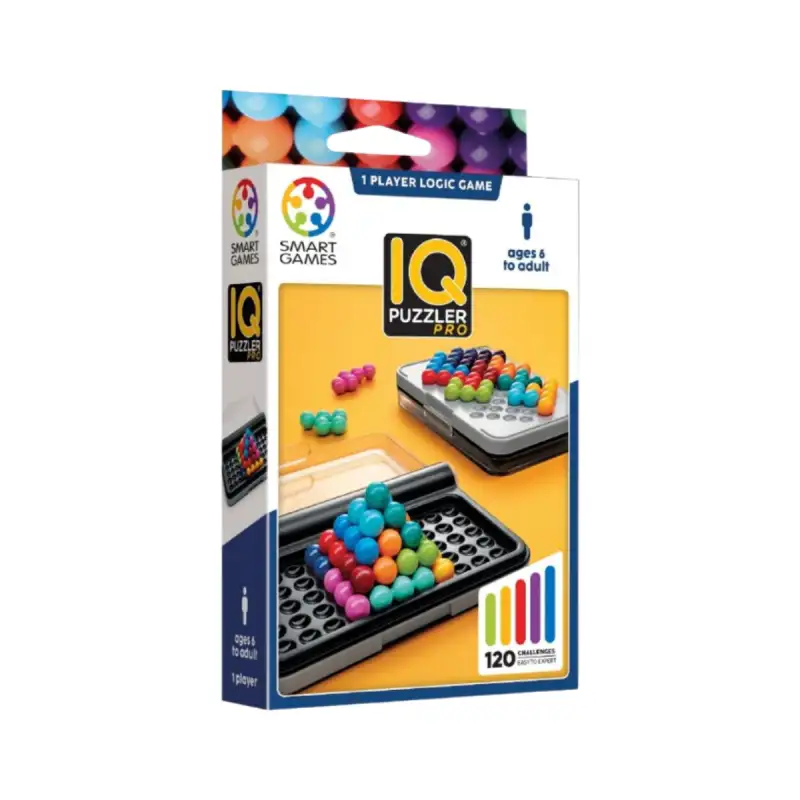
The SmartGames IQ Puzzler Pro earns our top recommendation because it packs an unusually large range of challenges into a compact case.
It includes 120 puzzles and can be played in both two-dimensional and three-dimensional configurations. Some challenges require fitting the pieces flat into the board, while others involve constructing pyramid-style arrangements.
That variety gives it an advantage over puzzle games built around a single mechanic. A player may begin with a straightforward spatial-fitting challenge and eventually encounter problems that require considerably more visualization and planning.
The progressive difficulty system is also well suited to focused practice. Easier puzzles provide quick wins, while the hardest challenges can require sustained attention and repeated experimentation.
Pros
- 120 progressive challenges
- Both 2D and 3D puzzle modes
- Compact self-contained case
- Excellent for spatial reasoning
- Encourages logical deduction
- Works well for short focus sessions
- Suitable for a wide range of skill levels
Cons
- Small pieces can be misplaced
- Difficult challenges may frustrate younger players
- Primarily a solo experience
- Some users may prefer a larger physical game board
Best for: Anyone who wants one compact puzzle game with enough variety and difficulty progression to remain interesting for a long time.
Verdict: SmartGames IQ Puzzler Pro is the best puzzle game for brain training and focus overall. Its combination of logic, visualization, concentration, and progressive challenge gives it exceptional replay value.
2. Educational Insights Kanoodle | Best Portable Puzzle
Key Features
- 200 2D and 3D puzzles
- Small, self-contained carrying case
- Colorful connected puzzle pieces
- Strong focus on spatial reasoning and visualization
- Quick setup for short play sessions
- Highly portable for travel
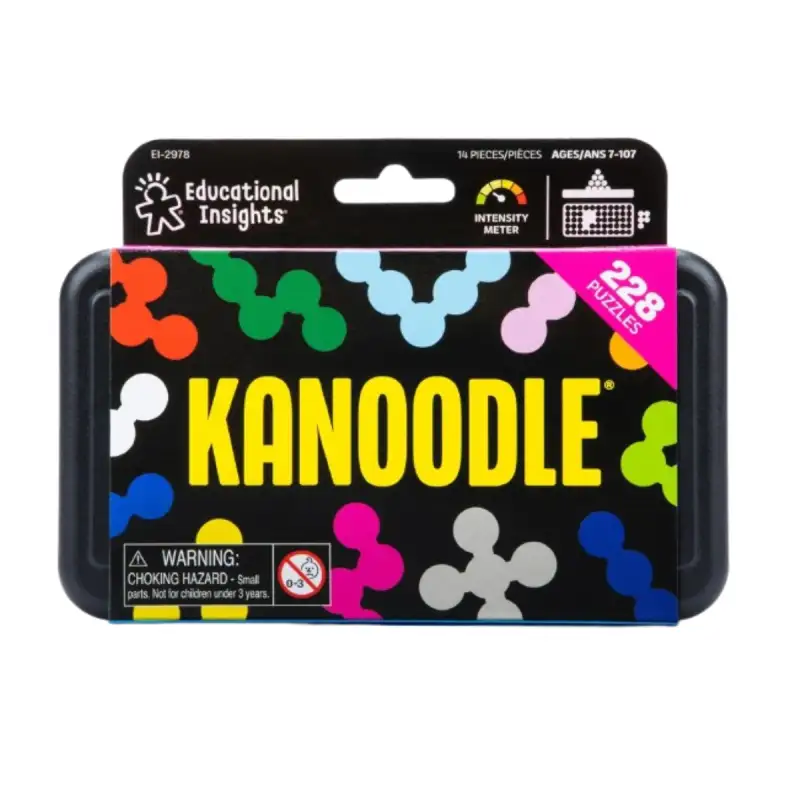
The original Kanoodle has become popular for a simple reason: it fits a large number of spatial puzzles into a case small enough to take almost anywhere.
The game uses colorful connected pieces that must be arranged according to increasingly difficult challenge diagrams. Some puzzles are flat, while others require three-dimensional constructions.
With 200 challenges, there is enough content for both beginners and experienced puzzle fans.
Because the entire game is stored inside its own case, Kanoodle is particularly well suited to travel, waiting rooms, lunch breaks, and other situations where pulling out a larger board game would be impractical.
Pros
- 200 challenges
- Very compact
- Pieces store inside the case
- Includes both 2D and 3D puzzles
- Quick to start playing
- No batteries required
- Excellent screen-free travel activity
Cons
- Pieces are small
- Most challenges emphasize spatial reasoning rather than memory
- Can become difficult quickly
- Best suited to solo play
Best for: Travelers, commuters, students, and anyone who wants a pocket-sized logic puzzle.
Verdict: Kanoodle is the best portable brain-training puzzle in this group. It offers an impressive number of challenges without requiring a large playing surface.
Also Read: The Best Mini Projectors for Outdoor Movie Nights
3. ThinkFun Rush Hour | Best for Planning
Key Features
- 40 progressive challenge cards
- Sliding-block traffic-jam puzzle
- Encourages planning several moves ahead
- Develops sequencing and logical reasoning
- Easy-to-understand rules
- Physical game board with cars and trucks
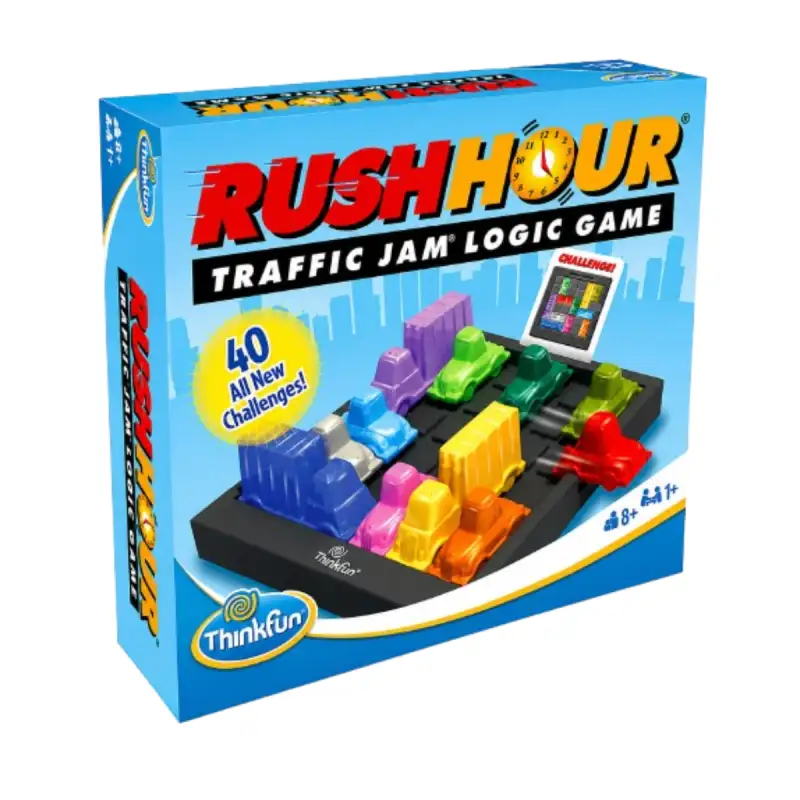
Rush Hour turns a simple traffic jam into an effective logic challenge.
Each puzzle begins with cars and trucks positioned on a grid. The goal is to slide the vehicles forward and backward until the red car can escape through the exit.
The concept is easy to understand, but difficult puzzles require considerably more thought than the colorful pieces initially suggest.
Instead of simply trying random moves, experienced players learn to think several steps ahead. Moving one vehicle may open space for another, which may then allow a third vehicle to move into position.
That makes Rush Hour especially good for practicing sequencing and planning.
Pros
- Straightforward rules
- 40 progressive challenges
- Encourages multi-step planning
- Strong logical reasoning component
- Physical pieces are satisfying to move
- Suitable for children and adults
- Easy to reset and replay
Cons
- Fewer challenge cards than some competitors
- Larger than pocket-sized puzzles
- Limited to one core puzzle mechanic
- Advanced challenges can take substantial time
Best for: Players who enjoy thinking several moves ahead rather than solving pure shape-fitting puzzles.
Verdict: ThinkFun Rush Hour is the best puzzle game for strategic planning and sequencing. Its sliding-block mechanic rewards deliberate thought instead of trial-and-error guessing.
4. SmartGames IQ Focus | Best for Concentration
Key Features
- 120 progressive challenges
- Central 3×3 color-matching objective
- Emphasizes concentration and visual attention
- Builds deduction and spatial reasoning
- Compact travel-friendly design
- Solo play format
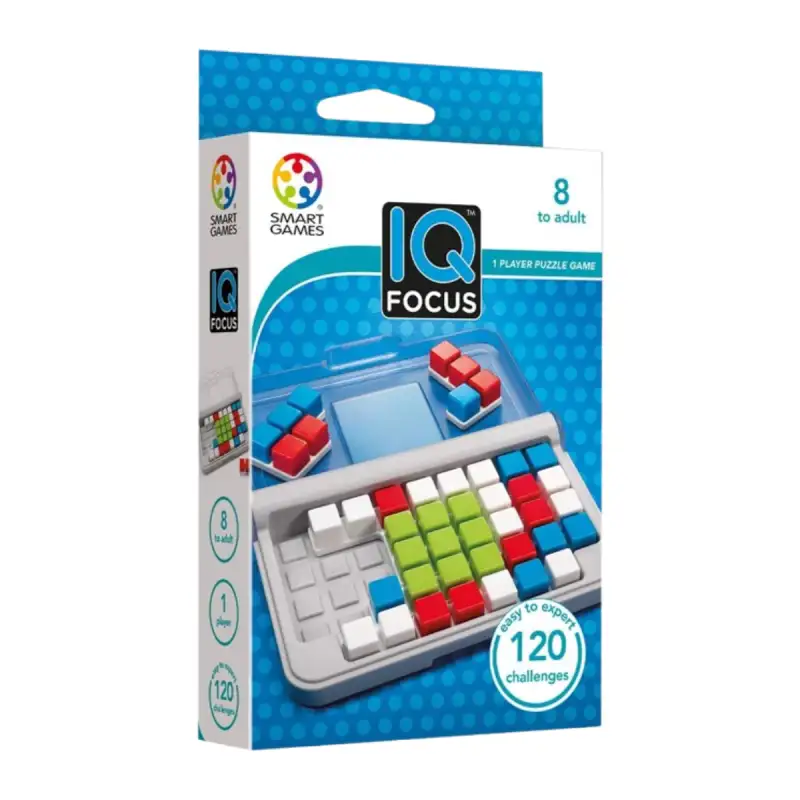
The SmartGames IQ Focus has a particularly appropriate design for anyone looking for a game centered on sustained attention.
Each challenge specifies which colors must appear inside a central 3×3 viewing area. The player must then arrange all the puzzle pieces so that the correct pattern appears in the center while the rest of the board is filled correctly.
This forces you to pay attention not only to the visible target but also to how every piece interacts with the surrounding spaces.
With 120 progressive puzzles, difficulty gradually increases rather than jumping abruptly.
Pros
- 120 challenges
- Strong concentration component
- Compact travel case
- Encourages careful observation
- Builds spatial reasoning
- Simple rules
- Increasing difficulty
Cons
- Small pieces require careful handling
- Less visually dynamic than games such as Gravity Maze
- Primarily appeals to solo puzzle fans
- Harder levels may require considerable patience
Best for: People who want a quiet puzzle centered on close attention, visual matching, and logical deduction.
Verdict: SmartGames IQ Focus is the best choice specifically for concentration practice. Its design rewards careful observation and discourages rushed guessing.
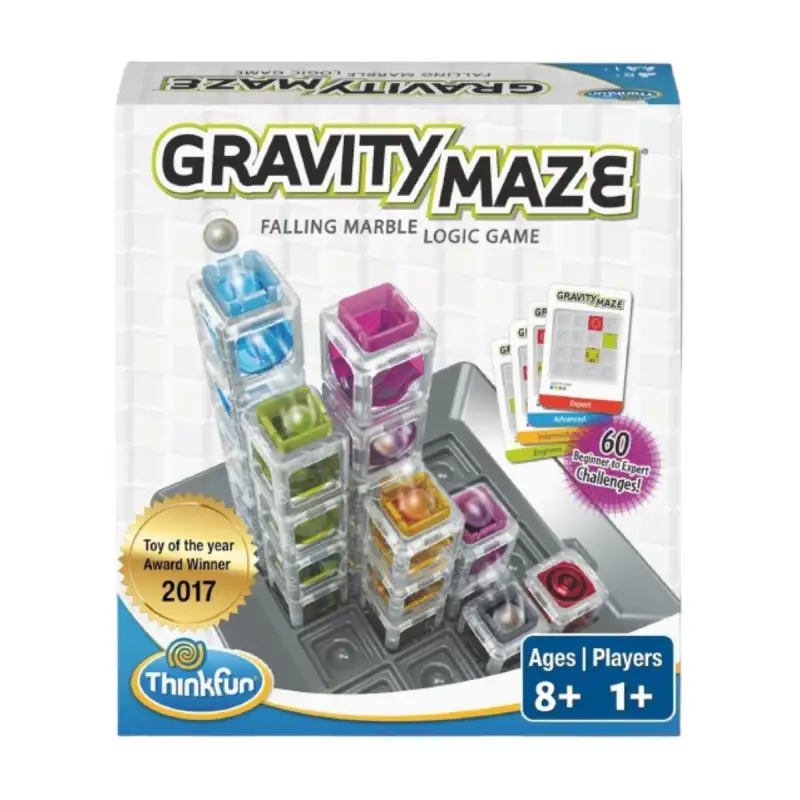
5. ThinkFun Gravity Maze | Best for Spatial Reasoning
Key Features
- 60 progressive challenges
- Combines a logic puzzle with a marble run
- Requires tower placement and rotation
- Builds spatial reasoning and planning
- Offers immediate physical feedback
- Strong STEM-style problem-solving element
Gravity Maze combines a logic puzzle with a marble run.
Each challenge shows where certain towers need to begin. The player then adds and rotates additional towers so that a marble dropped from the starting point travels successfully to the target.
That adds a physical cause-and-effect element missing from ordinary fitting puzzles.
Players have to visualize how the marble will move vertically and horizontally before testing the solution. Incorrect setups provide immediate feedback when the marble takes the wrong route.
Pros
- 60 progressive challenges
- Strong spatial-reasoning component
- Combines logic with physical movement
- Immediate feedback
- Engaging for STEM-oriented players
- More visually dynamic than flat puzzles
- Encourages experimentation
Cons
- More pieces to organize
- Larger than pocket-sized games
- Marble can be lost
- Some children may focus on free play instead of the challenges
Best for: Players who enjoy engineering-style puzzles, marble runs, and visualizing how objects move through space.
Verdict: ThinkFun Gravity Maze is the best spatial-reasoning puzzle in this comparison. Its combination of planning, prediction, and physical feedback makes problem-solving especially engaging.
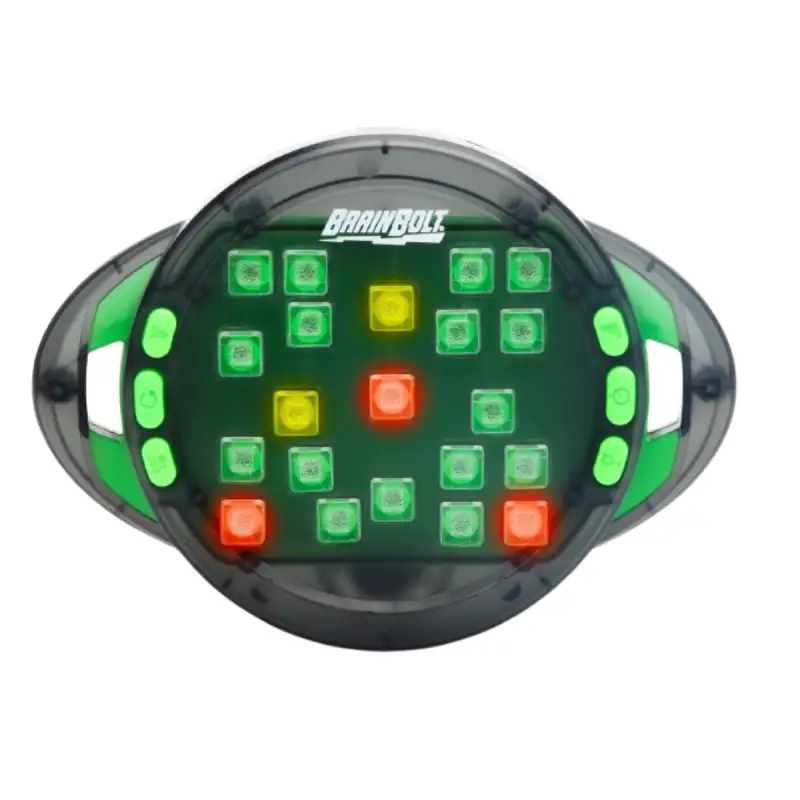
6. Educational Insights BrainBolt | Best Memory Game
Key Features
- Electronic light-sequence memory game
- Progressive difficulty
- Focuses on memory, attention, and reaction
- Handheld portable design
- Quick, repeatable play sessions
- Immediate visual feedback
Most of the games in this guide focus heavily on spatial reasoning. BrainBolt takes a different approach.
This handheld electronic game presents sequences of illuminated buttons that the player must remember and reproduce. The patterns become increasingly challenging as play continues.
That makes it better suited to practicing short-term sequence recall and sustained attention than shape-fitting puzzles.
Its self-contained design also makes it easy to use during short breaks.
Pros
- Focuses on memory and attention
- Portable handheld design
- Easy to learn
- Progressive challenge
- Immediate feedback
- Works for short practice sessions
- Different mental challenge from spatial puzzles
Cons
- Requires batteries
- Electronic lights may not appeal to players seeking a completely screen-free feel
- Less strategic than Rush Hour
- Repetitive for players who dislike sequence-memory games
Best for: Anyone specifically interested in memory, attention, and rapid sequence recall.
Verdict: BrainBolt is the best memory-focused puzzle game in the group. It provides a useful change of pace from the spatial and logic challenges offered by most physical brain games.
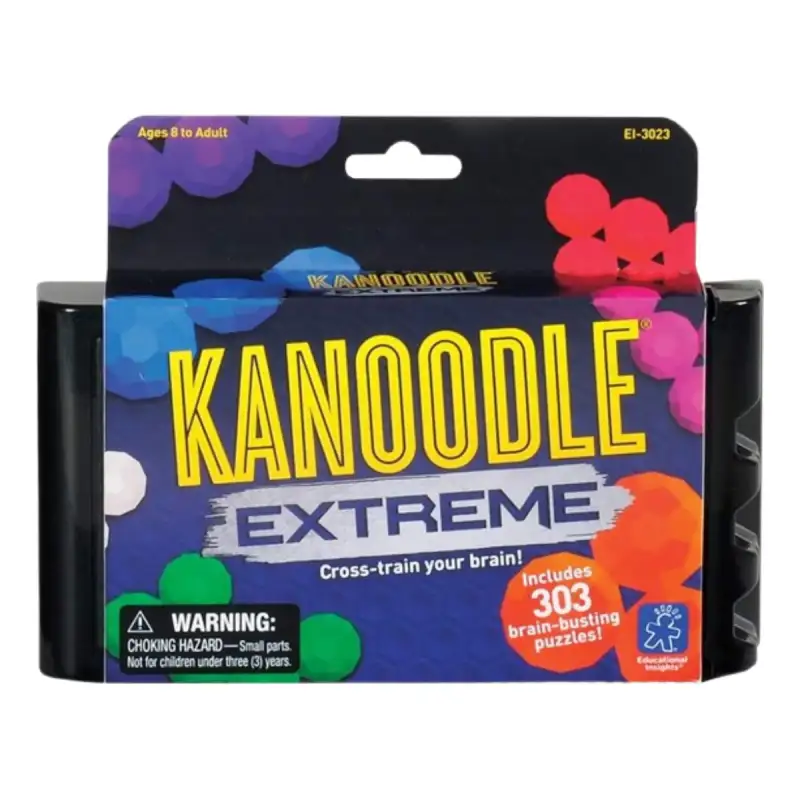
7. Kanoodle Extreme | Best Advanced Challenge
Key Features
- 303 challenges
- Multiple 2D and 3D puzzle styles
- More advanced than standard Kanoodle
- Strong spatial-reasoning focus
- Compact storage case
- Designed for experienced puzzle fans
If the standard Kanoodle eventually becomes too easy, Kanoodle Extreme provides a major step up.
It includes more than 300 challenges and offers several different puzzle styles. Players can work on traditional 2D arrangements, sliding-style puzzles, and three-dimensional constructions.
The larger challenge library makes it particularly attractive to experienced puzzle enthusiasts who tend to finish smaller puzzle books quickly.
Pros
- More than 300 challenges
- Multiple puzzle styles
- Excellent long-term replay value
- Strong spatial-reasoning focus
- Compact design
- Good progression for experienced players
- Substantial challenge library
Cons
- Less beginner-friendly
- Small pieces can be lost
- Harder puzzles can become frustrating
- Primarily suited to solo play
Best for: Experienced puzzle fans who want a more demanding challenge than standard travel brain teasers provide.
Verdict: Kanoodle Extreme is the best advanced puzzle game in this comparison. Its large challenge library and varied puzzle formats make it suitable for players who want something genuinely difficult.
8. Rubik’s 3×3 Cube | Best Classic Puzzle
The Rubik’s 3×3 Cube remains one of the most recognizable logic puzzles ever created.
Unlike games based on printed challenge cards, the cube has essentially unlimited replay value. A scrambled cube can be solved repeatedly, and players can continue improving their technique even after learning a successful solution method.
Beginners often start by recognizing color patterns and learning basic sequences. More experienced users memorize algorithms, improve finger movements, and work toward faster solving times.
That gives the cube a different kind of progression from the other products in this guide.
Pros
- Nearly unlimited replay value
- Compact and portable
- No batteries required
- Encourages pattern recognition
- Requires sequence recall
- Huge range of difficulty depending on solving method
- Easy to carry anywhere
Cons
- Learning the first solution can feel intimidating
- Often requires studying solving methods
- Repeating memorized algorithms becomes less logic-intensive over time
- Cheap cube mechanisms can feel stiff
Best for: Anyone who wants a classic puzzle that can evolve from casual solving into a long-term skill.
Verdict: The Rubik’s 3×3 Cube is the best classic brain puzzle because its challenge does not end after a fixed number of cards have been completed.
What Mental Skills Can Puzzle Games Exercise?
Different puzzle games emphasize different abilities, so the best choice depends on what type of challenge you enjoy.
1. Concentration
Games such as IQ Focus require attention to small visual details and discourage careless moves.
Concentration-based puzzles can be particularly useful as a structured break from phones and other distractions.
2. Spatial reasoning
Spatial puzzles require you to mentally rotate, arrange, or reposition objects.
Examples include:
- IQ Puzzler Pro
- Kanoodle
- Kanoodle Extreme
- Gravity Maze
These games require players to visualize how pieces relate to one another in space.
3. Planning
Planning puzzles require thinking several moves ahead.
Rush Hour is a strong example because moving one vehicle can affect several later moves.
4. Working memory
Sequence games such as BrainBolt require retaining information temporarily while acting on it.
The Rubik’s Cube also involves sequence recall once players begin learning solving algorithms.
5. Logical deduction
Many single-player challenge games provide a fixed starting arrangement with one or a limited number of valid solutions.
Players must gradually eliminate impossible options until the correct arrangement becomes clear.
How to Choose a Brain-Training Puzzle Game
1. Look for progressive difficulty
A puzzle game should not be so easy that it becomes boring after a few sessions.
The best challenge systems include:
- Beginner puzzles
- Intermediate puzzles
- Advanced puzzles
- Expert-level puzzles
Gradual progression creates a clearer sense of improvement and makes the game accessible to more users.
2. Choose a puzzle type you actually enjoy
A game cannot provide sustained practice if it spends most of its time in a drawer.
Consider whether you prefer:
- Shape-fitting puzzles
- Sliding-block puzzles
- Memory sequences
- Mechanical puzzles
- Marble runs
- 3D construction
- Pattern recognition
Enjoyment matters because consistency is more useful than choosing a supposedly more sophisticated game that you rarely play.
3. Consider session length
Some puzzles can be completed in a few minutes, while others may take much longer.
Good for short breaks
- Kanoodle
- IQ Focus
- BrainBolt
- Rubik’s Cube
Better for longer sessions
- Rush Hour
- Gravity Maze
- IQ Puzzler Pro
- Kanoodle Extreme
A compact puzzle that can be started immediately is particularly useful for replacing short periods of passive phone use.
4. Check portability
If you plan to use the game while traveling, look for:
- A self-contained case
- Secure piece storage
- Few loose components
- Small packed dimensions
- No requirement for a large table
Kanoodle and IQ Puzzler Pro are especially convenient in this respect.
Physical Puzzles vs. Brain-Training Apps
Both formats can provide challenging activities, but physical puzzles offer several advantages.
| Feature | Physical puzzle game | Brain-training app |
|---|---|---|
| Screen-free | Yes | No |
| Tactile interaction | Excellent | Limited |
| Notifications/distractions | None | Possible |
| Portability | Good to excellent | Excellent |
| Challenge variety | Depends on game | Usually high |
| Battery required | Usually no | Yes |
| Replayability | Varies | Often extensive |
| Physical manipulation | Yes | No |
Physical puzzles can be particularly appealing when the goal is to take a deliberate break from screens.
Tips for Getting More From Puzzle Games
- Start below your maximum difficulty: A few successful puzzles help establish the rules and patterns before harder challenges.
- Avoid checking the solution too quickly: Spending time testing possibilities is part of the challenge.
- Take a break when completely stuck: Returning later often makes overlooked patterns easier to notice.
- Replay older puzzles: Try solving them more efficiently or without repeating unnecessary moves.
- Rotate between different puzzle types: Switching among memory, spatial, and planning games keeps sessions varied.
- Keep one puzzle near your workspace: A five-minute physical puzzle can provide a more intentional break than automatically reaching for a phone.
- Increase difficulty gradually: Jumping immediately to expert puzzles can turn a useful challenge into frustration.
Frequently Asked Questions [FAQs]
Puzzle games can provide practice in specific skills such as spatial reasoning, attention, memory, planning, and problem-solving. They should not be treated as a guaranteed way to increase general intelligence or prevent cognitive decline. Their strongest benefit is providing an engaging way to repeatedly use particular mental skills.
SmartGames IQ Focus is our top choice for concentration because its challenges require close attention to a specific visual target while simultaneously solving the larger puzzle. IQ Puzzler Pro is another excellent option.
IQ Puzzler Pro is our best overall recommendation because its advanced challenges remain demanding enough for adults. Kanoodle Extreme and the Rubik’s Cube are also excellent choices for experienced puzzle solvers.
BrainBolt focuses most directly on short-term sequence memory and attention. The Rubik’s Cube can also involve significant sequence recall once players begin learning algorithms.
Many are, provided the difficulty and small-piece requirements are age-appropriate. Games such as Rush Hour and Gravity Maze can be particularly engaging because they combine problem-solving with physical pieces.
Kanoodle is our favorite travel option because the pieces and challenge material fit into a small self-contained case. IQ Puzzler Pro is another highly portable choice.
There is no required duration. A focused session of 10 to 20 minutes can be enough to work through several challenges, while difficult puzzles may keep enthusiasts occupied much longer.
Final Recommendation
The SmartGames IQ Puzzler Pro is our best overall puzzle game for brain training and focus. Its 120 progressive challenges, combination of 2D and 3D play, compact case, and emphasis on logical and spatial reasoning make it one of the most versatile options available.
Choose Kanoodle if portability is the priority. Its 200 challenges fit into a small case that can easily travel in a backpack or bag.
For planning and sequential thinking, ThinkFun Rush Hour is the strongest choice. Players need to consider how each move affects future possibilities rather than simply fitting shapes into spaces.
SmartGames IQ Focus is particularly well suited to concentration, while Gravity Maze offers an engaging combination of spatial reasoning and physical cause-and-effect.
Anyone specifically interested in memory should consider BrainBolt, while experienced puzzle fans will get more mileage from Kanoodle Extreme.
And for a puzzle that can be practiced almost indefinitely, the Rubik’s 3×3 Cube remains difficult to beat.
